|
Dance Band Encyclopaedia |
Introduction |
To Dance Music |
| Home page | London Places | Label Index | Musicians | Sound Files |
What Type Of Dance Music The Site Is About
I want to try and document all I can about dance bands of the 1920s & 1930s, especially British ones, even though the interest in the music seems to be fading. I would be very grateful for any information and especially scanned photographs which I can publish here. I can give you acknowledgments or you can remain anonymous as you please. Don't hesitate to tell me my mistakes either. I can take it!
You may e-mail me by clicking here.
I've been
collecting dance music on 78s since 1970, when I was a mere 12 year old, along
with my cousin, Charles Hippisley-Cox (who is a year younger than I). Our
parents hoped it was just a phase we were going through, as they saw the bedroom
floors of our respective homes bowing with the weight. I now have about 13,000
records* and it is still growing..... Charles
and I may be seen at the Birmingham Record fair at the National Motorcycle
Museum, both trying to sell records
and buy 'em.
*A rough
count undertaken on November 25th, 2001: About 12,500 dance & jazz records & 500 ragtime / early popular
vocal 78s.
One of my other main interests is Genealogy. I am documenting my family tree in another section of my web site. Click here to return to my front page and visit the Genealogy section if you're interested.
What Dance Music Is This Web Site About?
This web site is concerned with the dance music that was prevalent between the two world wars in the 20th century.
To start with, it was very much of a ragtime style, played generally by a small orchestra, the instruments would depend on the location. It could have included cornets, trombones, horns, clarinets, flutes, tubas and drums and maybe strings, or it could have been a trio playing in a tea-shop. On record, the larger orchestra is generally heard, with exceptions.
The exceptions are the likes of The Original Dixieland Jazz Band, making their recording debut in 1917, consisting of cornet, trombone, clarinet, piano & drums.
There were banjo quartets consisting of two banjos, piano
& drums. Some other trios of saxophone, piano and xylophone.
Also novelty groups, such as the Six Brown Brothers, all playing
various saxophones.
Anything went, really. But then in 1920, Paul Whiteman in America asked his friend and colleague, Ferde Grofe, to try and get it down on paper for an orchestra. He set the standard, really; Whiteman's orchestra consisted of 2 trumpets, trombone, 3 saxes, violin, piano, banjo, tuba and drums. This became the normal orchestration for a dance band or orchestra for the next twenty years! The saxophone and banjo came to signify the music of this period.
The acoustic recording methods being used required the more percussive and up-front sound of the banjo and tuba, but once electrical recording (generally introduced in 1925-6) became established, the banjo made way for the guitar; the tuba for the double bass. Interestingly, some photographs of dance bands in the early 1920s show the use of the double bass & guitar, but the acoustic horn couldn't record either of them very well.
Most dance bands were quite small, probably 6 to 8 pieces, in the early 1920s, but gradually they grew, especially the show bands like Whiteman's, which was about 30 strong by 1928!. In England, Jack Hylton was Whiteman's counterpart, though it wasn't until the end of the 1930s that his band was this huge.
In the mid-1930s, America was taken over by Swing Music (like "dance music", this is another term that has recently been hijacked for a kind of modern pop music). This was played 4-in-a-bar rather than 2. It was exciting and different and appealed to the young. The bands were usually 14 or 15 piece and revolved around the bandleader, who was a top-player of his instrument. The names of Benny Goodman, Artie Shaw, Tommy Dorsey, Bunny Berigan, Harry James, Woody Herman all come to mind. The music was either instrumental, the tune revolving around a couple of riffs (repeated musical phrases) or reviving an old tune of about 10 years previous, or they were "pop" songs of the day, played rather slow and sensuously. The style got into a rut rather quickly, the songs were always played at the same speed, the arrangements were minimal, revolving as I said, around the playing of the bandleader. The instrumentals became a bit "samey" too; there are only so many riffs and only so many ways to play them.
The style survived, though, through the war and generally evolved into a "Big Band" style using a big 20+-piece orchestra. In England, bands never really took to swing and the British music papers gave it the thumbs-down for being all the same. English dance music became more sophisticated in its arrangements and the vocalist became more important during the later 1930s. The war helped this along, as those vocalists, such as Vera Lynn & Denny Dennis, toured the country (and abroad), boosting the morale of the troops. It was relatively easy for one entertainer to tour, and use local musicians as accompaniment, compared to trying to move a big orchestra around. After the war, dance music gradually faded as the singers took over the popular music scene. As usual, there were exceptions, like Ted Heath's big band, but most other bands slipped into an accompanying role.
In America, it wasn't all swing, though the alternative was often even more set in its ways. The so-called "Mickey-Mouse" bands, using a novelty technique in every record which soon became tiresome. Shep Fields blowing bubbles in a glass of water, for instance. Guy Lombardo, who seemed to only have one arrangement to play. There were the bands in between, so to speak, such as Freddy Martin, Vincent Lopez etc, playing quality dance music, smooth and sophisticated. They survived in one form or another right into the 1960s, but times had changed.
So, on this site you will eventually find a comprehensive set of pictures and history of the record labels around in the 1920s & 1930s (with some earlier & later ones too - It's my page and I'll make my own rules!). Photographs of the bands and musicians and information about them. Please be patient, there are a lot of bands - it will take ages to bring all the information together. Being English and living in England, I will be concentrating on British bands, and I'll be grateful for any help, especially with photograph scans of recording artists.
Links To Other Sites Of Interest
Discussion groups:
British
Dance Bands e-group.
Discussion group covering anything to do with British dance bands of 1920s -
1940s.
Join in.
Don't be shy !!
American
Dance bands e-group.
As
above but for American dance bands, of course.
Australian
Dance Bands e-group
Lively
group for those interested in dance bands "down under".
Al
Bowlly discussion group
Are you a "fan" of Al Bowlly's singing? Then come and share your
views here.
Whether novice or expert, you'll find friendly advice and
discussion here.
Websites about 1920s & 1930s music and 78s:
John
Wright's page of Vintage Jazz and Dance Music at 78rpm
Lots of stuff about bands in films too. Well worth a visit
or 200 !!
The
Big Band Database
American site worth visiting - lots of information about British and American
bands.
This site was
run by Murray L Pfeffer, who, sadly, passed away in 2008 and the website not
longer exists.
However, Doug
Henkle is attempting to save some of the webpages and his site can be found
here.
Norman Field's website about early British record labels
Norman's comprehensive site about British acoutic-era record labels. Go there
now!
Norman Field's original website
The
'old labels' section has been moved to the site above,
but Norman still has interesting articles about 78s, early technology and music
here.
Tim
Gracyk's web-site
Tim's in California and has some interesting stuff on his page.
He has also
published some books about early recording artists.
Mainspring
Press
An online journal about American record labels and artists of the 78 era.
Also a book
publisher - has published the new "Jazz Records" discography in 2002.
Bill
Clark's 78rpm pages
An English site covering the early years of recording and Music Hall.
Memory
Lane
The popular magazine featuring dance bands (mainly British) of the 1930s &
40s
now has it's own web-site.
The
Official Jack Hylton Website
Peter Faint's site devoted to Jack Hylton with detailed
biography, photographs and lots
of Real Audio sound files.
Hans Koert's "Keep
Swinging" site
Hans' site
has details of his research into flexible records and other relevant information
(Note: Hans died in 2015, but his website is still live when I last checked.)
The
Phonograph Webring
Lists over 100 other sites pertaining to records and gramophones etc
Die
Gesellschaft fur Historische Tonterager
This German organisation is covering the gramophone and record industry in
Germany.
It incorporates The Phono Museum and
The Lindstrom Project.
The site is mostly in
German, as you'd expect, but do have a look.
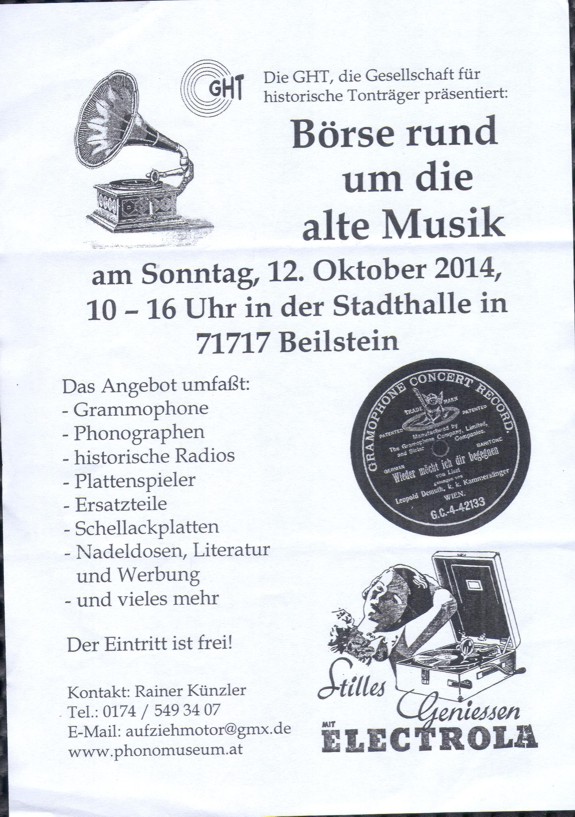
They
are organising a record fair in Germany in October 2014.
Click here to see the details.
Another list of links to websites about old records & gramophones
NOTE: All the sites where you can buy records mentioned below are genuine and reliable. I use them regularly myself and am personally acquainted with most of the people running them.
Resources - where you can buy CD reissues of 1920s-30s dance band records
Dutton
Labs & Vocalion CDs
Mike Dutton is at the helm producing excellent CD transfers for the Vocalion
label.
Lots of dance band CDs available here as well as vintage classical and
light music - and
inexpensive too!
Maybe you are still buying 78s or LPs? Here are a few places where they can be found
VJM (Vintage Jazz Mart)
VJM has many record auction listings which may be to
your taste. Some auctions are online.
There are also many fine articles here and in the magazine as
well.
Mark Berresford
Mark is
co-owner of VJM and also has his own website where he posts occasional
auctions of
records. Click on his name to go there.
Sadman Records
Sadman
records is run by Nigel Haslewood. Nigel is in Leicester and deals in 78s &
LPs -
anything with
a Jazz, Dance Band or Blues link. He runs regular auction lists and also has
a
market stall
in Leicester Market on Thursdays (stall D36).
Alan Cooperman
Alan is in
the States and runs regular on-line auctions of 78s, concentrating on
Jazz,
Dance Band
and Popular music.
What you may need to play your 78s:
Expert Stylus Company
A
very long established company. They can supply cartridge & stylus
replacements to suit
all your needs for
playing records. They have no website, I'm afraid, but you can write,
telephone, fax or email to the following address: (I
have found it best just to phone!)
Expert Stylus Company, PO Box
3, Ashtead, Surrey KT21 2QD, England
Telephone: 01372-276604 Fax: 01372-276147
Email: w.hodgson@btclick.com
Dance bands that may still be heard today! (in alphabetical order) (Click on name to go to website)
The Ashby Big Band
Formed in 2006, this band plays big
band music similar to the bands of Glenn Miller and Ted Heath.
It is run by David Bradford and they play in the Derbyshire and Noth
Staffordshire area.
Bert Firman's Dance Orchestra
No, I
haven't made a mistake; Pete March, who organises the band, was given permission
by the
late Bert Firman to perpetuate his name. As you'd expect, the band plays music
of
the
1920s, generally genuine arrangements of the period, too. They play gigs in the
Walsall
area
and have a regular spot at the Lyttleton Arms, Hatherton Street, Walsall,
on the first
Monday
every month, bar bank holidays.
The
New Foxtrot Serenaders
A dance band playing the music of the 1920s & 1930s, based in the South
East of England.
A CD of their recordings are available too.
The
Palm Court Dance Orchestra
A 9-piece band of musicians recreating the 1920s & 1930s music, based in the
Leeds,
Yorkshire district. See their site by clicking on the name above.
The Pasadena
Roof Orchestra
Probably the longest established vintage orchestra, the PRO were formed in
1969.
They are only
orchestra I have seen live, and they are, in my opinion, excellent.
The Piccadilly Dance Orchestra
Formed in 1988, the Piccadilly Dance Orchestra concentrate mainly on the 1930s,
and have
been playing
at The Savoy Hotel, London
since 1997 and have performed before royalty!
The Regency Dance Band
A six-piece band formed in 1983 which plays the
music of the 1920s, 30s & 40s, based in North Staffordshire.